
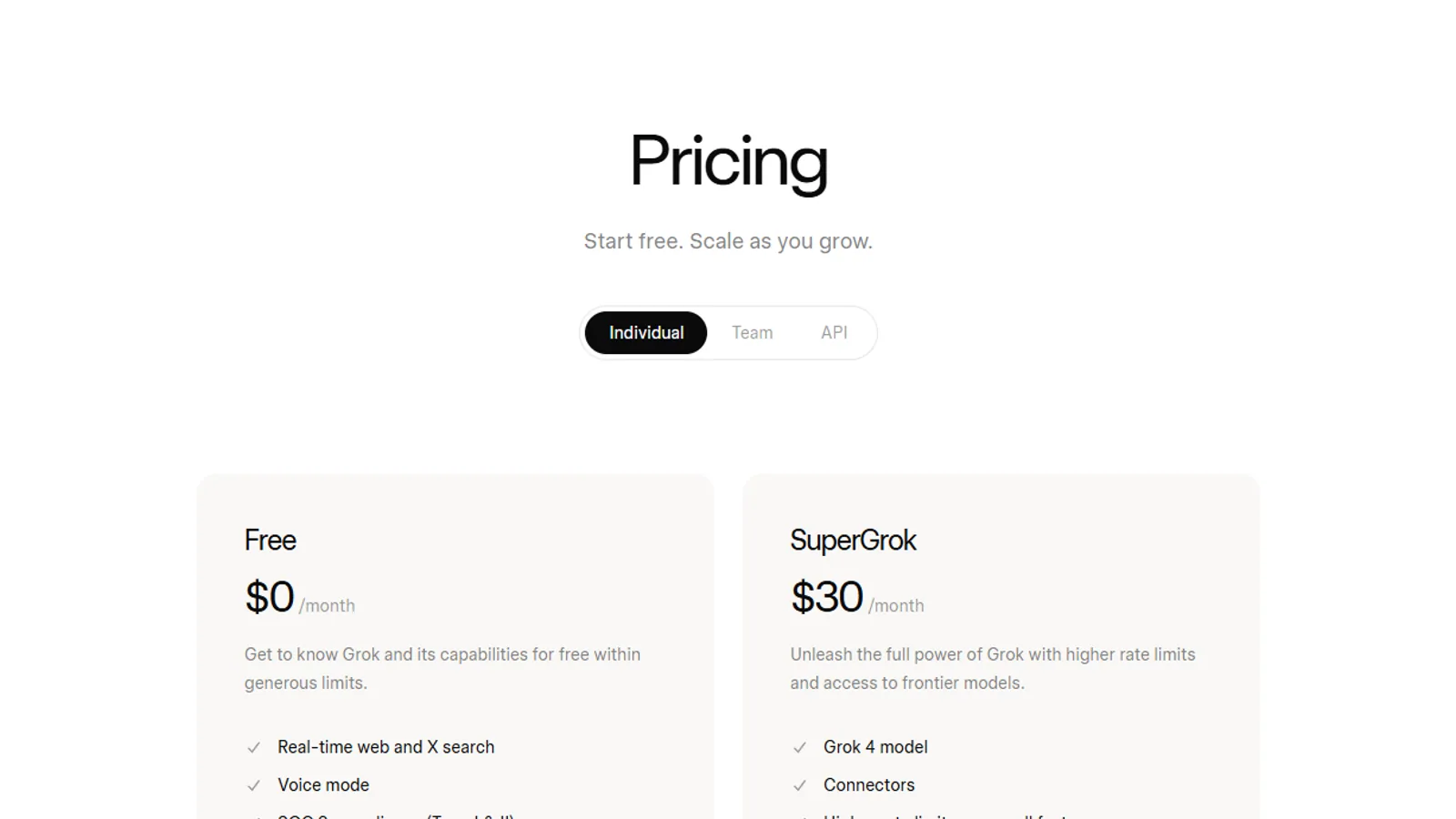
Choose SuperGrok for regular personal use and pick SuperGrok Heavy only when you already know that standard paid access is the bottleneck; both paid tiers share a weekly usage allowance, so verify current terms on the official xAI page before upgrading.
SuperGrok Heavy sounds like the obvious best plan, but the best plan is the one that solves your actual bottleneck. If you are not regularly hitting a limit, Heavy may be an expensive answer to a problem you do not have.
Decision table
| Your usage pattern | Better starting point | Why |
|---|---|---|
| Occasional questions | Personal Workspace (free tier) | You need more usage evidence before paying more |
| Daily personal AI work | SuperGrok | Standard paid access may be enough |
| Heavy research sessions | SuperGrok or Heavy | Upgrade only if standard paid access still blocks you |
| Business workflows | Business or Enterprise | Admin, billing, and compliance matter more than consumer tiers |
| API development | xAI API docs and pricing | Consumer plan names may not map to API needs |
When SuperGrok is enough
SuperGrok is likely enough when Grok is useful but not mission-critical. If your questions are spread across the day and you rarely hit limits, a standard paid plan can be the more rational choice.
It also gives you a clean trial period for your own behavior. Spend a billing cycle noting what you actually use before moving higher.
When Heavy starts to make sense
Heavy starts to make sense when you can complete this sentence: "I need Heavy because standard paid access blocks me when I try to..."
Good reasons might include sustained high-volume research, repeated heavy sessions, or a need for more capacity during time-sensitive work. Weak reasons include curiosity, status, or assuming the highest tier is always smarter.
What to verify at xAI
- The current Heavy price in your country.
- Whether Heavy changes model access, capacity, priority, or limits for your exact surface.
- Whether the subscription is through xAI, Grok, an app store, or X.
- Cancellation and renewal terms.
- Any business or enterprise alternative if the use case is work-related.
Upgrade threshold worksheet
Before upgrading from SuperGrok to Heavy, write down:
| Question | Your answer |
|---|---|
| What task was blocked? | |
| How often did it happen in the last seven days? | |
| Did the block stop paid work, study, research, or casual use? | |
| Did you switch to another AI tool because of it? | |
| Would waiting have been acceptable? | |
| Does the official Heavy plan language address this exact problem? | |
| What will you review after one billing cycle? |
If the worksheet is mostly blank, do not upgrade yet. If it shows a repeated capacity problem tied to work you value, Heavy deserves a closer look.
Do not confuse capacity with intelligence
Readers often assume a higher tier automatically means smarter answers. Sometimes a higher tier may affect access, priority, capacity, model availability, or product positioning, but the exact meaning has to be verified on the official page.
Capacity and intelligence are different buying questions. Capacity asks whether you can do more work, longer sessions, or more frequent prompts. Intelligence asks whether the model gives better answers for your tasks. A plan can help with one and not the other.
Before upgrading, run the same task on your current plan and ask what actually failed. Did the answer quality fail, or did the limit interrupt you? Did you need better reasoning, or did you need more room to continue? Did a different AI tool solve the task better, or did Grok solve it but stop too soon?
If the issue is answer quality, Heavy may not be the first fix. You may need a better prompt, a different model surface, or another AI tool. If the issue is repeated capacity pressure, Heavy is more relevant.
A capacity-first decision
The Heavy decision should start with capacity. Ask what happens when regular paid access is not enough. Do you stop working? Do you wait? Do you switch to another tool? Do you lose time during a task that matters?
If the answer is "not really," Heavy is probably premature. If the answer is "yes, every week," it may deserve a closer look.
Capacity can mean several things:
- More room for repeated prompts.
- Better fit for long sessions.
- A plan positioned for heavier access.
- Less friction during time-sensitive work.
The official xAI page is still the place to verify what Heavy currently includes. This guide helps you decide whether the question is worth asking.
Capacity bottleneck examples
Real bottleneck: you run research sessions for work, the conversation stops or slows at the same point several times a week, and switching tools costs time.
Weak bottleneck: you occasionally want to ask more questions after casual browsing. That may be annoying, but it may not justify the higher tier.
Real bottleneck: you prepare daily briefs, compare multiple sources, and need Grok available during a time-sensitive workflow.
Weak bottleneck: you want the highest plan because it sounds more powerful, but you have not tested the standard plan with real work.
Real bottleneck: a creator or analyst uses Grok repeatedly around fast-moving X context and can name the days when capacity changed the work.
Weak bottleneck: one impressive demo made Heavy feel necessary before you tested your own tasks.
Prompt patterns that reveal real usage
Use repeatable prompt patterns during a trial period:
- "Summarize these notes into actions, risks, and unanswered questions."
- "Compare these two options and tell me what evidence would change the recommendation."
- "Explain this topic for a beginner, then for a technical reader."
- "Rewrite this draft without adding claims I did not provide."
- "List what I should verify on the official page before paying."
Run those prompts on normal days, not only when you are excited about testing. Heavy is easier to justify when the same patterns keep appearing in real work.
If your usage is mostly one-off entertainment prompts, a higher tier may still be enjoyable, but the value case is weaker. If your usage is repeated research, writing, or analysis, the review becomes more concrete.
Personal use examples
SuperGrok may be enough for a reader who uses Grok for planning, research, writing help, and occasional comparison with other tools.
Heavy may be worth evaluating for a reader who runs long research sessions, tests multiple drafts, compares answers throughout the day, or treats Grok as a primary work assistant.
Neither plan should be chosen only because it is the most talked about option. The better plan is the one that matches your actual pattern.
Worked plan examples
Reader A asks ten casual questions a week and rarely returns to the same conversation. Heavy is almost certainly too much. This reader should keep testing Free or a lower paid path.
Reader B uses Grok every workday for notes, explanations, and comparison with other AI tools. SuperGrok may be a reasonable first paid test, especially if the free experience already feels limiting.
Reader C runs multi-hour research sessions, generates outlines, checks public context on X, and switches tools when limits appear. Heavy is worth evaluating if official plan language shows that it solves the capacity problem.
Reader D is buying for a company team. Heavy may still be the wrong question. Business or Enterprise details matter more because the organization needs billing control, account ownership, and a reviewed data workflow.
Team and business warning
If more than one person needs access, do not solve that with a personal Heavy plan by default. Teams often need billing control, account ownership, offboarding, procurement review, and support expectations.
For a company, the right question may be Business or Enterprise, not Heavy. That is especially true if work data, customer data, or regulated information may be involved.
Heavy vs another AI subscription vs API
Sometimes the answer is not Heavy. It may be another AI subscription, a lower Grok plan, or xAI API usage.
Choose Heavy only when the constraint is Grok capacity or plan access for your personal workload.
Choose another AI subscription when a different tool performs better for the task: long documents, coding, image work, office-suite integration, or a privacy posture your organization prefers.
Choose xAI API exploration when you need model calls inside software, automation, or a product. API decisions depend on docs, pricing, rate behavior, and engineering constraints, not consumer plan names.
Choose Business or Enterprise when more than one person needs access or an organization needs procurement, support, account ownership, and data review.
The wrong upgrade can hide the real problem. If the issue is workflow fit, Heavy may give you more of a tool that still does not solve the job.
Monthly review checklist
If you upgrade to Heavy, review after one billing cycle:
- How many days did you use the higher tier?
- Which tasks would have failed or slowed down without it?
- Did it replace another paid tool?
- Did it create better work, or just more usage?
- Would a lower plan now be enough?
If Heavy does not pass that review, downgrade or pause. AI plans should earn their place each month.
One-billing-cycle review scorecard
After one billing cycle, score each category from 1 to 5:
| Category | What a high score means |
|---|---|
| Usage frequency | You used Heavy on many days, not only at the start |
| Capacity value | The higher tier removed a real blocker |
| Work quality | Outputs helped you finish better work |
| Time saved | You spent less time waiting or switching tools |
| Review burden | The extra output did not create too much checking work |
| Replacement value | It reduced the need for another paid tool |
| Confidence | You can explain why the higher tier remains useful |
If the total is weak, downgrade or pause. If the total is strong and the official plan details still match your use case, Heavy may have earned another month.
When to downgrade
Downgrading is not failure. It is normal subscription hygiene.
Downgrade if you used Heavy heavily for the first few days and then stopped. Downgrade if the higher tier did not replace another tool or save meaningful time. Downgrade if you cannot explain what would break on a lower plan. Downgrade if your work shifted away from Grok.
Keep Heavy if the higher tier repeatedly removes a bottleneck, improves important work, and still matches the official plan details. The decision should be boringly practical.
Cost versus attention
Heavy usage has a second cost besides money: attention. If more capacity makes you ask more questions but does not improve the final work, the plan may feel productive while creating extra review time.
Measure the full loop. Did Grok help you finish the task faster? Did you spend less time switching tools? Did the answer reduce uncertainty, or did it create more checking work? A higher tier is valuable when it improves the whole workflow, not only the number of prompts you can send.
This matters for students, writers, analysts, and developers. More generations can help with exploration, but final decisions still need verification, editing, and judgment.
If the higher plan creates more unfinished drafts than finished work, the bottleneck was not capacity.
Avoid this mistake
Do not compare only plan names. Compare the constraint. If your constraint is privacy, Heavy may not solve it. If your constraint is X Premium access, a Grok plan may not solve it. If your constraint is API usage, consumer subscriptions may not solve it.
What changes could alter the answer
The best plan can change when xAI changes model availability, app features, country availability, or plan positioning. A new Grok release can make a standard plan more attractive, or it can make Heavy more valuable for certain users.
That is why the right buying habit is to check the official plan page at the moment of purchase and again after major xAI announcements.
Recommendation by reader type
Casual reader: start free or with the lowest suitable paid option.
Regular personal user: evaluate SuperGrok first.
Heavy researcher: test SuperGrok, then compare whether Heavy removes a real limit.
Developer: start with xAI Docs and API details.
Team buyer: start with Business or Enterprise information.
A note on feature wording
Plan pages often use short marketing phrases because they need to fit a pricing table. Those phrases are useful starting points, but they are not a full workflow review. If a phrase says a plan is for heavier use, translate it into your own day: number of sessions, type of work, time sensitivity, and whether you can pause when capacity is lower.
That translation is what prevents overbuying. Heavy is valuable only if the extra capacity maps to a real pattern in your usage.
Bottom line
Choose SuperGrok when you want more Grok access for regular personal use. Choose SuperGrok Heavy only when you already know that standard paid access is the limiting factor. For work teams or API usage, start with official business, enterprise, or developer pages instead.
Next, read the full plans and pricing guide or compare Grok with other AI tools.
Questions readers ask
Should casual users choose SuperGrok Heavy?
Usually no. Heavy makes sense only when regular paid access is not enough for your workload.
What should I check before upgrading?
Check xAI pricing, checkout terms, model access, usage limits, and whether the bottleneck you hit is actually solved by Heavy.
Sources checked
- xAI pricingxAI
- xAI developer modelsxAI Docs
- Grok app on Google PlayGoogle Play