
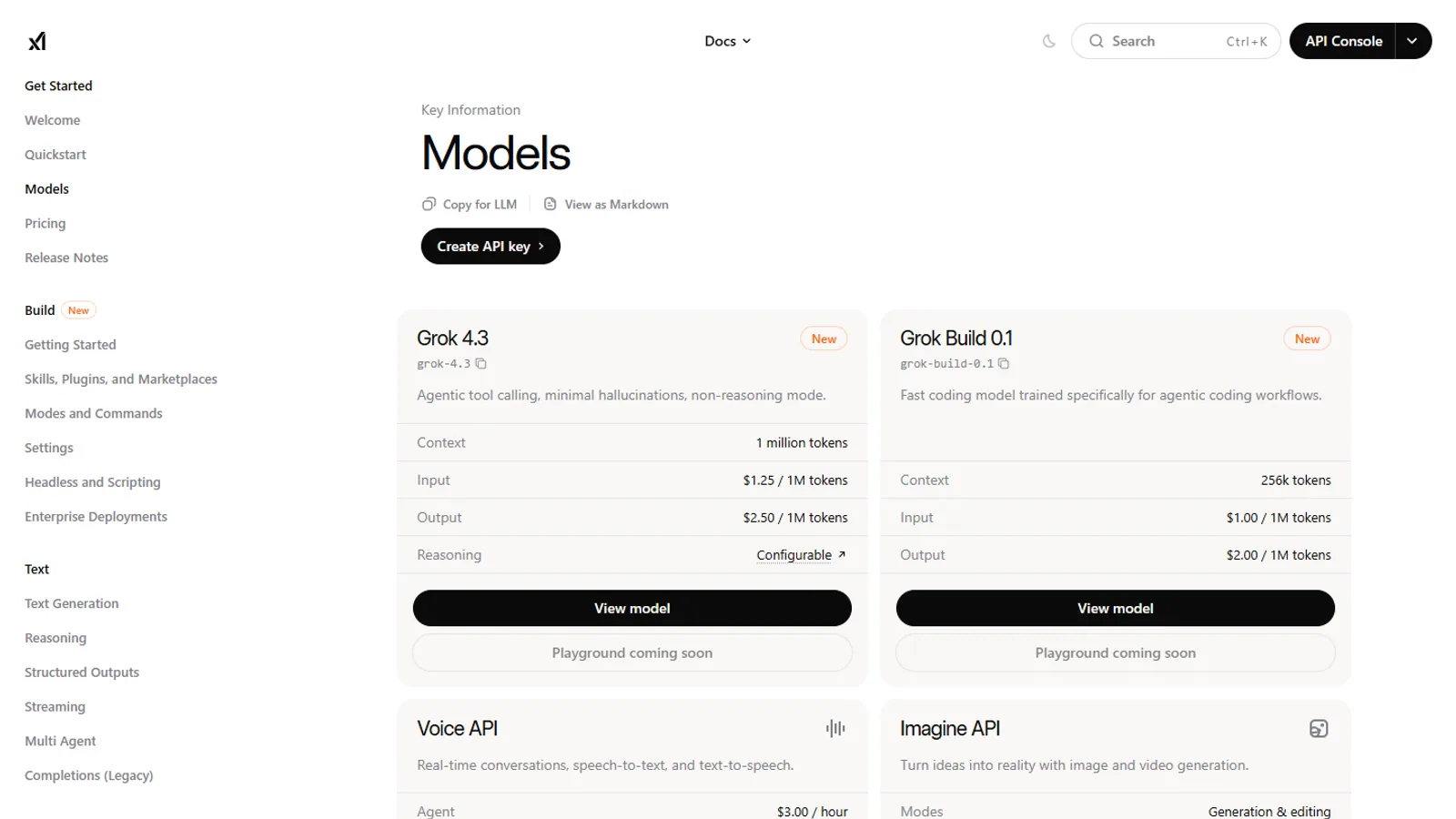
Elon Musk publicly said Grok 4.5 is in private beta inside SpaceX and Tesla and claimed it performs near or above Anthropic's Claude Opus. That announcement is real. What is not confirmed by xAI: any benchmarks, a system card, parameter counts, training details, a plan that includes it, or a public release date. The official model docs still list grok-4.3 as the current flagship, with no Grok 4.5 entry. Treat the specs circulating in coverage as unverified reporting until xAI publishes them.
Elon Musk said Grok 4.5 is in private beta. That part is real and sourceable. Almost everything else you have read about it is not.
The short version
On June 28, 2026, Elon Musk posted on X that Grok 4.5 had entered private beta and was being tested internally at SpaceX and Tesla. He added that early results put its performance close to, and possibly above, Anthropic's Claude Opus. Multiple outlets reported the same post within a day.
So the announcement itself is confirmed in the narrow sense that matters: a named person made a public, dated statement, and you can read it. What is not confirmed is the substance behind it. xAI has not published a benchmark, a system card, a model page, a plan that includes Grok 4.5, or a public release date. The official developer documentation still lists grok-4.3 as the current flagship and does not mention a 4.5 model at all.
This page exists to hold that line. When a founder announces a model that no one outside two of his companies can use, the honest job is to separate the sourceable claim from the specs that are circulating without a source.
What Musk actually announced
Strip the coverage back to what came from Musk directly, and the confirmed claims are short:
- Grok 4.5 exists as an internal build.
- It is in private beta, restricted to SpaceX and Tesla for now.
- Musk says its early performance is near or above Claude Opus.
- Musk also said xAI intends to release new models, trained from scratch, on a roughly monthly cadence through the rest of 2026.
That is the full set of first-party statements. Everything in that list is a claim by the person building the product, which is useful context but is not the same as a tested, documented release. A private beta inside your own companies is the earliest, least public stage a model can be in. It means engineers can try it. It does not mean a benchmark ran, a safety review published, or a consumer can sign up.
What xAI has not confirmed
Here is the part that most coverage blurs. As of this writing, xAI has not published any of the following about Grok 4.5:
- A model card or system card describing the model.
- Any benchmark numbers, in any category.
- A parameter count or training-data description.
- A knowledge cutoff.
- A place in the official model catalog at docs.x.ai.
- A consumer plan that includes it.
- A price.
- A public release date.
If a claim about Grok 4.5 is not on that list of confirmed items and is not on an official xAI page you can open, it is not established fact. That includes the widely repeated figures: a 1.5 trillion parameter foundation model, a specific training completion date, and the detail that Cursor coding data was used in training. Those appear in secondary coverage, not on an xAI page. They may turn out to be accurate. Right now they are unverified reporting, and this site will not present them as confirmed.
Where Grok 4.5 sits against the official model catalog
The most grounding thing you can do while a rumor cycle runs is to check what the official documentation actually lists. The xAI developer model docs are the operating source of truth for what you can call and what xAI officially supports.
Today those docs describe grok-4.3 as the flagship: a one million token context window, text and image input to text output, and language calling it the most intelligent and fastest model. The prior flagship, grok-4.20, is still in the catalog in its reasoning, non-reasoning, and multi-agent variants. There is also grok-build-0.1, an agentic coding model in early access.
There is no Grok 4.5 entry. That absence is not proof the model is fake. It is proof that the model is not yet a supported, documented product you can rely on. The gap between "the founder mentioned it" and "the docs list it" is exactly the gap between a headline and a plan you can actually use.
How to read the "better than Opus" claim
Founders compare their unreleased models to the strongest available competitor. It is a normal part of a launch narrative, and it is worth almost nothing as evidence until numbers appear.
A performance claim needs three things before it means anything to you: a named benchmark, a reproducible setup, and a result someone outside the company can check. Musk's statement has none of those. Claude Opus is a strong, well-documented reference point, which makes the comparison sound concrete, but a comparison to a real model is still just a comparison until the measurement is public.
So the right reading is: xAI believes its next model is competitive at the top of the field, and it wants that message out early. Treat that as positioning. When a system card and independent tests arrive, you can revisit the claim with actual data. Do not rearrange your tools around a sentence.
What a private beta at SpaceX and Tesla means, and what it does not
A private beta scoped to Musk's other companies is an unusual test bed, and it is easy to over-read. It does not mean the model is ready for the public. It does not mean it is safe for general use. It does not mean any consumer plan is about to include it. It means a controlled group of internal users, on real internal work, is putting an early build through its paces.
There is a reasonable logic to it. SpaceX and Tesla generate hard engineering and coding problems, and Cursor-style coding workflows are exactly where a new model's weaknesses show up fast. If the reporting about coding-focused training data is accurate, testing inside heavy engineering shops is a sensible way to find failure cases before a wider audience does. That is a plausible story. It is still a story until xAI documents it.
The monthly-model claim and what to watch
The more consequential statement may be the cadence one: new models, trained from scratch, released monthly for the rest of 2026. If that holds, model names will move faster than most buyers can track, and the practical risk is not missing a release, it is overreacting to each one.
The thing to watch is not the announcement. It is the documentation trail behind it. For any model xAI names next, look for four concrete signals before you treat it as usable:
- It appears in the developer model docs with a real model id.
- It has a model or system card describing capabilities and limits.
- A named plan states it is included, or the API lists it with a price.
- xAI's own release notes or news page cover it, not just a repost of a tweet.
When all four are present, the model is a product. When only the first-party excitement is present, it is a preview of intent. This is the same discipline our xAI Grok model timeline applies to every release: a name on social media is not a buying decision until you can connect it to an official page.
What this changes for SuperGrok and API users right now
Nothing, yet. If you pay for SuperGrok or SuperGrok Heavy, your plan is unchanged. If you build on the API, your model names and behavior are unchanged. There is no Grok 4.5 to select in either place, because it is not shipped.
That is the calm and correct answer during a rumor cycle. The usage mechanics that actually govern your account, the shared weekly allowance on paid plans and the option to add credits when the pool runs low, are described in the official FAQ and are not affected by an internal beta. When Grok 4.5 becomes something you can use, the questions worth asking are practical: which plan includes it, whether it changes the weekly allowance, whether the API model id and price change, and whether it is available in your country. None of those have answers today because the model is not public.
For the decisions you can make now, the grounded references are the current pricing structure in SuperGrok plans and pricing and the model-by-model view in Grok vs ChatGPT vs Claude vs Gemini. Both describe products that exist and that you can actually buy or call.
How to tell confirmed from rumor on your own
You do not need this site to referee every claim. A simple test works for any Grok 4.5 statement you encounter:
- Can you trace it to an xAI page (docs.x.ai, x.ai, help.x.com) or a named, dated statement from xAI or Musk? If yes, it is at least sourceable.
- Does it come with a number that no official page publishes, such as a parameter count, a benchmark, or a price? If yes, and there is no xAI page behind it, it is unverified.
- Is it a capability or availability claim ("it can do X", "it is available in plan Y")? Those need a docs entry or a plan page, not a screenshot.
Apply that and most of the noise sorts itself. The private beta and the Opus comparison pass the first test as attributable statements. The specs fail the second test. The availability claims fail the third.
Why xAI announces this early
It is worth understanding why a model gets announced before it is documented, because the pattern repeats and knowing it keeps you calm. Early announcements serve the company, not the buyer. They signal to talent that the lab is moving fast, they reassure investors that the roadmap is alive, and they keep xAI in the conversation during a stretch when rivals ship often. A single sentence from Musk on X can generate a week of coverage at no cost, which is a strong reason to say something the moment an internal build shows promise.
None of that is a criticism. It is normal competitive behavior in a field where attention is scarce and models leapfrog each other quickly. The problem is only on the reader's side, when a positioning statement gets treated as a spec sheet. The founder's job is to build excitement. Your job, if you are choosing tools or writing code against a model, is to wait for the parts that excitement cannot fake: a documented model id, a published limit, a measured benchmark, and a price.
This is also why the "monthly new models" line deserves a skeptical ear. Training capable models from scratch every month is an enormous claim about compute, data, and evaluation throughput. It may describe an ambition rather than a schedule. If xAI does ship at that pace, the documentation trail will show it, one dated model page at a time. If the pages do not appear, the cadence was aspirational. Either way, the docs settle it, not the announcement.
A useful habit: when you see a Grok 4.5 claim, note whether it tells you something you could act on, or something you could only feel. "It beats Opus" is a feeling until a benchmark makes it actionable. "It is in the docs with this id and this price" is actionable the moment it is true. Sort claims into those two buckets and the rumor cycle loses its power to rush you.
How we will update this page
This article is dated and will move as the facts move. When xAI publishes a Grok 4.5 model page, a system card, benchmarks, a plan inclusion, or a release date, the confirmed section here gets rewritten to match, with the official source linked and a fresh verified date. Until then, the summary at the top is the honest state of things: a real announcement, a founder's performance claim, and a set of specs that no official page has confirmed.
If you came here after seeing a confident headline about Grok 4.5's power or release, the useful takeaway is smaller than the headline. A capable model may well be coming. What has actually been shown is a private test and a claim. Keep the two apart, and you will not have to unwind a decision when the documentation finally lands.
Bottom line
Grok 4.5 is not something you can use today, and its specifications are not confirmed by xAI. What is confirmed is narrow: Musk said it is in private beta at SpaceX and Tesla, and he claimed it rivals Claude Opus. The official catalog still centers on grok-4.3. Watch the developer docs and xAI's own release notes for the four signals that turn an announcement into a product, and treat everything else as reporting to verify, not fact to act on.
Questions readers ask
Is Grok 4.5 available to buy or use right now?
No. Elon Musk said it is in a private beta limited to SpaceX and Tesla. There is no public release, no plan that lists it, and no consumer sign-up. The official developer docs still show grok-4.3 as the current flagship with no Grok 4.5 entry.
Did xAI confirm Grok 4.5 beats Claude Opus?
No. That is Musk's own claim from a post on X. xAI has not published benchmarks or a system card, so the comparison is unverified. Read it as a founder's statement, not a measured result.
Are the 1.5 trillion parameter and training-date figures official?
No. Those numbers come from third-party coverage, not from an xAI page. Until xAI publishes a model card or release note, treat every spec you see as unverified reporting.
What should I do if I use SuperGrok or the API today?
Nothing changes yet. Your plan and your API model names are unaffected until xAI ships Grok 4.5 publicly and lists it in the docs. Keep using the models that appear in your account.