
On July 8, 2026, Elon Musk said Grok 4.5 would open to the public, calling it an Opus-class model that is faster, more token-efficient, and lower cost. TechCrunch, Bloomberg, and Seoul Economic Daily all reported the launch, with a developer price widely quoted at 2 dollars per million input tokens and 6 dollars per million output tokens. That much is well sourced. What is not yet verifiable: the performance benchmarks, the parameter and GPU figures, and the official price and docs entry, because x.ai and docs.x.ai return 403 to automated checks. Treat the capability claims as positioning until a system card and independent tests land.
Grok 4.5 has moved from a private test inside Musk's companies to something developers can reportedly call today. That is the real news. The performance claims around it are not news yet, because no one outside xAI has measured them.
The short version
On July 8, 2026, Elon Musk said Grok 4.5 would open to the public, and he framed it in one line: an Opus-class model that is faster, more token-efficient, and lower cost. TechCrunch and Bloomberg both reported the announcement the same day. Seoul Economic Daily reported on July 9 that the model was available through xAI's developer surfaces, with a wider regional rollout described as the middle of the month.
Across that coverage, one number is quoted consistently: a developer API price of 2 dollars per million input tokens and 6 dollars per million output tokens. Outlets contrast that with Claude Opus, which the same coverage puts at 5 dollars input and 25 dollars output per million tokens. If those figures hold, Grok 4.5 is priced to sit well under the strongest coding model it is being compared to.
So the launch itself is well sourced. Three independent outlets, plus xAI's own announcement page, all describe the same event on the same dates. That clears the bar this site sets for reporting a development: a dated event, confirmed by more than one source you can trace.
What does not clear that bar is everything about how good the model actually is. That is the part worth slowing down on.
Why we treat this carefully
This site tracks Grok for a living, and the last time Grok 4.5 was in the headlines, in late June, it was a private beta with no public numbers. We covered it in what Musk announced about the private beta and said plainly that a founder's statement is not a spec sheet. That article listed four signals that turn an announcement into a product: a real model id in the docs, a system card, a named plan or API price, and coverage in xAI's own release notes rather than a reposted tweet.
This launch appears to hit several of those signals at once. There is now an official announcement page, a developer price quoted everywhere, and access through xAI's console and coding tools. That is a genuine step up from a private beta. It is why this is a fresh, publishable event and not a rerun of the June story.
But there is a specific limit we have to be honest about. The pages that would let us verify the launch first-hand, x.ai/news and docs.x.ai, return a 403 to automated fetch tools. That is not new. It is the same block that keeps this site from machine-reading the pricing page. It means we are relaying what credible outlets report, not what we read off the official source ourselves. A human editor can open those pages in a normal browser, confirm the model id and price, and stamp this article with a live verified date. Until that happens, the numbers here are reported, not confirmed by us.
What is confirmed by multiple sources
Here is the set of claims that more than one independent outlet supports. This is the part you can lean on.
- xAI announced Grok 4.5 on July 8, 2026, and began opening it to developers and the public around July 9.
- Musk described it as an Opus-class model that is faster, more token-efficient, and lower cost than the model it is compared to.
- The developer API price is reported as 2 dollars per million input tokens and 6 dollars per million output tokens.
- The model is positioned around software coding and agentic tasks, the same territory where Claude Opus is strong.
- Cursor, the AI coding tool, is named as a collaborator on the model, and Bloomberg frames the launch partly around legal and finance workflows.
Each of those appears in at least two of TechCrunch, Bloomberg, and Seoul Economic Daily. The coding focus and the Cursor tie-in are the most consistently repeated details, which makes sense: a model that wants to challenge Opus has to compete on code first, and a coding-tool partner is a fast way to get real developer workloads in front of it.
What is only a vendor claim
Now the part the aggregators run as fact and this site will not.
The heart of the launch narrative is that Grok 4.5 matches or beats Claude Opus. That is Musk's framing and xAI's positioning. It is not a measured result. xAI released some benchmark metrics of its own, described in coverage as competitive but short of best in class, along with a claim of roughly twice the token efficiency of rivals. Company-run benchmarks are a starting point, not a verdict. They are chosen and configured by the team with the most to gain from a good number.
At launch there was no independent testing corroborating a blanket beats-Opus claim. Early third-party notes pointed the other way on quality: quick, yes, but not clearly ahead of the strongest current models on output quality in coding tasks. That is the pattern to expect from a model tuned for speed and cost. It can be a genuinely good deal on price per token and still not top the quality charts. Those are two different questions, and a launch line that blurs them is doing marketing, not measurement.
The honest reading: xAI believes 4.5 is competitive at the frontier and priced to win on cost. Whether it is as capable as Opus on hard, real work is exactly what independent benchmarks are for, and those take days to weeks to arrive. Do not rearrange your stack around a comparison until someone outside the company has run it.
What no official page has verified
Below the benchmark claims sits a layer of technical detail that is even softer. Some coverage describes Grok 4.5 as running on a new 1.5 trillion parameter foundation, several times the size of the architecture behind grok-4.3, and trained on tens of thousands of Nvidia GB300 GPUs. Those specifics are striking, and they are also the least sourced part of the story.
TechCrunch, notably, reported no parameter counts and no GPU specifics from xAI. The bigger numbers appear in secondary coverage, not in the primary announcement as relayed by the outlets closest to it. That does not make them false. It makes them unverified. A parameter count and a training-hardware figure are the kind of claim that belongs in a model card, and until xAI publishes one, treat every such number as reporting to confirm, not fact to cite.
One more naming note worth flagging so you are not confused reading around: several outlets now refer to the company as SpaceXAI rather than xAI in their headlines. We use xAI here, consistent with the model docs, and we are not asserting any corporate restructuring as fact on the strength of a headline style. If that changes, it will change with a source behind it.
How Grok 4.5 sits against the model catalog
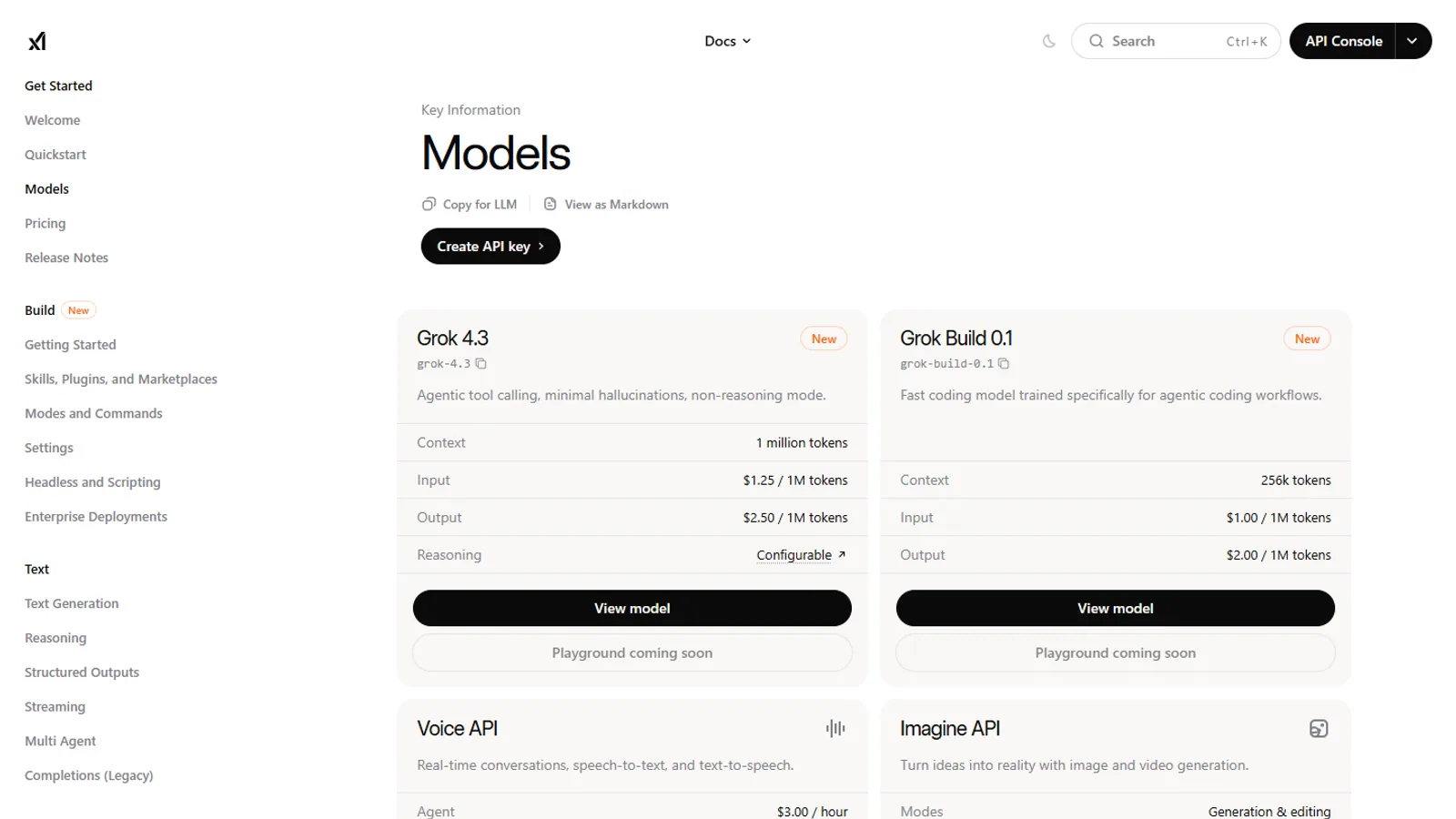
The grounding move during any launch is to check the developer docs, because that is the operating source of truth for what you can actually call. Before this week, the catalog centered on grok-4.3 as the flagship, a one million token context window, text and image input to text output, alongside the grok-4.20 family and grok-build-0.1 for agentic coding.
If Grok 4.5 is now live, the docs should show it with a real model id, a context window, an input and output modality, and a price. That is the entry that turns a headline into something you can build against. We could not read that entry ourselves today. So the practical instruction is simple: when you open docs.x.ai, look for the grok-4.5 id and confirm the context window and price match what launch coverage claims. If the docs and the coverage disagree, the docs win. Our Grok API pricing and costs guide is built around exactly that catalog, and it is the reference to reconcile against once the 4.5 entry is confirmed live.
What this means for coding and agent builders
If you build agents or write code against models, this launch is aimed squarely at you, and the calculus is mostly about price against quality. A model at 2 dollars input and 6 dollars output, if verified, is dramatically cheaper per token than a top-tier coding model at 5 and 25. For high-volume agent loops, where a task can burn millions of tokens across many steps, that gap compounds fast and can decide which model is even viable for a workload.
The catch is that cheap tokens only help if the output is good enough to avoid rework. A model that is quick and inexpensive but needs more retries, more human correction, or produces subtly wrong code can cost more in real time than a pricier model that gets it right the first time. That is why the beats-Opus question is not academic for builders. It is the whole decision.
The sensible play right now is to test it on your own tasks rather than trust either the vendor line or the early skeptics. Run your real prompts, your real repositories, your real agent chains, and measure quality and cost together. A model this cheap is worth an afternoon of evaluation even if you end up keeping your current setup. For a broader model-by-model view while you do that, the Grok vs ChatGPT vs Claude vs Gemini comparison lays out where each model earns its place.
What this changes for SuperGrok and consumer plans
For most people paying for Grok through a consumer plan, the immediate answer is that little has changed today, and anything about consumer pricing needs a live check. The 2 dollars and 6 dollars figures are API prices for developers, not a subscription number. Whether Grok 4.5 appears inside SuperGrok, SuperGrok Heavy, or the X Premium tiers, and at what cost, is a separate question that the API launch does not answer.
We do not fabricate consumer prices on this site, and the official pricing page blocks automated reading, so any subscription figure has to be confirmed in a browser before we would state it [VERIFY PRICE against x.ai/pricing]. If you are deciding on a plan, the mechanics that actually govern your account, the shared weekly usage allowance on paid plans and the option to add credits when the pool runs low, are unchanged by a new API model. Our SuperGrok plans and pricing guide walks through those mechanics, and it is the place to check once xAI states where 4.5 lands for consumers.
The wider week around it
Grok 4.5 did not launch into a quiet week. Coverage points to a crowded stretch of releases, with reporting that OpenAI is expected to bring out its next GPT family within a day of the Grok launch. We are not treating unreleased competitor models as fact here, and their names and dates are the kind of thing that shifts, so we will cover them on their own dated events rather than fold rumor into this piece. The context that matters for a Grok reader is narrower: xAI is shipping fast, pricing aggressively, and aiming at the coding and agent market where the strongest incumbents already sit. That is a real strategic move regardless of how the benchmarks shake out.
For the running view of how these releases stack up over time, the xAI Grok model timeline is where each confirmed release gets placed against the last, with the same discipline this page uses: a name in a headline is not a product until a documented model id, a published price, and an outside benchmark all line up.
How we will update this page
This article is dated and will move as the facts firm up. The open items are specific. First, a human editor confirms the grok-4.5 model id, context window, and price directly at docs.x.ai and stamps a live verified date. Second, when a system card or independent benchmarks appear, the vendor-claim section here gets rewritten around measured results, with the tests linked. Third, if and when xAI states where Grok 4.5 sits in consumer plans, the consumer section gets a real answer in place of the placeholder.
Until those land, the summary at the top is the honest state of things. A real launch, confirmed by three independent outlets and an official announcement. A developer price that is consistently reported but not yet read by us off the source. A stack of capability and hardware claims that no page we can open has verified. Keep those three buckets apart and you will not have to walk back a decision when the documentation finally settles it.
Bottom line
Grok 4.5 is here in the sense that matters most: xAI announced it, credible outlets confirm it, and developers can reportedly use it at a price that undercuts the model it is chasing. What is not established is whether it is as good as that model on the work you care about. The launch is fact. The comparison is a claim. Verify the price and the docs entry live, test the quality on your own tasks, and treat the beats-Opus headline as a starting hypothesis rather than a result until someone outside xAI has measured it.
Questions readers ask
Is Grok 4.5 actually available now?
According to TechCrunch, Bloomberg, and Seoul Economic Daily, xAI announced Grok 4.5 on July 8 and began opening it to developers and the public around July 9, with a wider regional rollout described as mid-July. That is a materially different stage from the private beta Musk described in late June. We could not open the official pages ourselves because x.ai and docs.x.ai return 403 to automated tools, so confirm live availability in your own account or console.
How much does the Grok 4.5 API cost?
Launch coverage consistently quotes 2 dollars per million input tokens and 6 dollars per million output tokens for the API. That figure is reported by multiple outlets, not read by us from the official docs, which block automated checks. Verify it live at docs.x.ai before you budget against it. This is a developer API price, not a consumer subscription price.
Does Grok 4.5 really beat Claude Opus?
That is a vendor claim, not a settled result. Musk said it is roughly comparable to Opus in capability while being faster and cheaper. At launch there was no independent testing corroborating a blanket beats-Opus claim, and early third-party notes suggested it trades some quality for speed. Wait for a system card and outside benchmarks before treating the comparison as measured.
Are the 1.5 trillion parameter and GPU figures official?
No. TechCrunch reported no parameter counts or GPU specifics from xAI. Numbers like a 1.5 trillion parameter foundation or tens of thousands of GB300 GPUs come from secondary coverage, not from an xAI page we can open. Treat them as unverified reporting until xAI documents them.
Sources checked
- SpaceXAI releases Grok 4.5, which Elon describes as an Opus-class modelTechCrunch
- SpaceXAI, Cursor Unveil Grok AI Model for Legal, Finance TasksBloomberg
- xAI launches Grok 4.5, taking on Anthropic in AI codingSeoul Economic Daily
- Introducing Grok 4.5 (official announcement)xAI
- xAI developer model documentationxAI Docs